







Securing funding is a critical step for any burgeoning startup.
But the path to a startup loan is often paved with rigorous financial scrutiny.
Lenders, from traditional banks to specialized small business loan providers, look for a clear indication of a borrower’s financial stability.
They also look for their ability to manage new debt.
Among the most vital metrics they evaluate is the debt-to-income ratio (DTI).
For entrepreneurs launching new ventures, understanding how this ratio is calculated and interpreted is paramount.
It is important for strengthening loan applications.
It is also important for navigating the complex world of commercial lending.
This article delves into the intricacies of DTI evaluation for startup loans.
It offers insights into what lenders seek.
It also explains how founders can present their best financial selves.
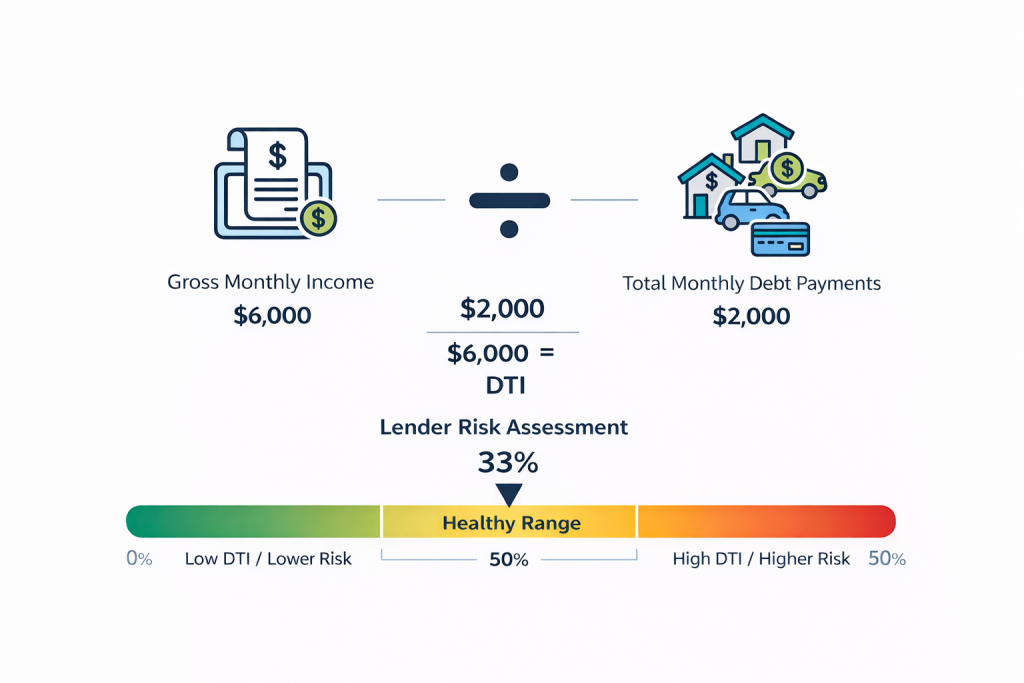
The DTI ratio is calculated by dividing your total monthly debt payments by your gross monthly income. Lenders use this percentage to quickly assess your capacity to take on new debt.
The debt-to-income ratio (DTI) is a fundamental financial metric used by lenders to assess a borrower’s capacity to repay debt.
At its core, it represents the proportion of a borrower’s gross monthly income.
This income is allocated to meeting their total monthly debt payments.
This ratio provides a snapshot of an individual’s or business’s ongoing financial obligations relative to their earnings.
For instance, if an individual earns a gross monthly income of $6,000 and has total monthly debt payments amounting to $2,000, their DTI would be approximately 33% ($2,000 / $6,000 x 100).
A lower DTI generally signifies a healthier financial situation.
It indicates that a larger portion of income remains available after debt servicing.
This presents a lower risk profile to potential lenders.
For startup loans, the debt-to-income ratio is especially crucial due to the inherent risks associated with new businesses.
Startups often lack the extensive financial history, established revenue streams, and proven track record that lenders look for in more mature businesses.
Consequently, lenders often lean more heavily on the founder’s personal financial standing.
This is largely reflected in their DTI.
A high DTI for the founder can signal that a significant portion of their income is already committed to existing debt.
This leaves less capacity for new loan repayments.
This raises concerns for lenders about the business’s potential to absorb unexpected expenses or market fluctuations during its critical early stages.
Conversely, a low DTI demonstrates financial discipline and available cash flow.
This reassures lenders that the founder has the personal financial cushion to support the business.
This is especially important when a personal guarantee is involved.
This metric is a key component of assessing the borrower’s overall financial health.
It also shows their ability to manage Total Debt.
When lenders calculate your debt-to-income ratio for a startup loan, they scrutinize all recurring monthly financial obligations that represent a commitment to repay borrowed funds or regular housing expenses.
This comprehensive approach ensures they get a clear picture of your financial burden.
Typically, the following debt payments are included:
It’s important to note that lenders primarily focus on the minimum required monthly payments rather than the total outstanding balance for most debts.
However, large outstanding balances, especially on credit cards, can still be viewed negatively by lenders as an indicator of financial strain, even if the minimum payment is low.
Understanding these components is vital for accurately calculating your monthly debt payments.
Most lenders generally seek a debt-to-income ratio below 40% for startup loans.
A DTI of 36% or lower is considered ideal, as it signals strong financial health and a lower lending risk.
Below 30% (Low Risk)
30% to 40% (Acceptable Range)
Approval often depends on:
Above 40% (High Risk)
Lenders may require:
DTI helps lenders understand how much of your income is already committed to debt.
For startups, this is especially important since income can be unpredictable in the early stages.
💡 Tip: Keeping your DTI at or below 36% can significantly improve your chances of approval and help you secure better loan terms.
The debt-to-income ratio is a primary tool lenders use to gauge the risk of extending credit, especially to startups.
For a new business, cash flow can be unpredictable, and the journey to profitability can be long.
A high DTI indicates that a borrower’s monthly income is already heavily committed to existing debt payments.
This leaves a narrower margin for error when unexpected expenses arise or if revenue streams falter, which is common in the startup phase.
If a founder’s DTI is high, it suggests a greater likelihood of financial strain if the business encounters a downturn.
Lenders want to see that the founder has enough disposable income to cover both their personal obligations and the new business loan payments without becoming overextended.
A manageable DTI signals that the borrower is more likely to:
This confidence is essential for lenders, as their primary concern is ensuring that the loan will be repaid.
By evaluating DTI, they aim to mitigate the lending risk associated with new ventures.
While a high debt-to-income ratio can present a challenge for startup loan approval, it does not automatically mean disqualification.
Lenders often employ a holistic approach, assessing your financial situation through various lenses.
If your DTI is on the higher side, a strong performance in other areas can significantly bolster your application and mitigate the perceived risk.
Lenders may still approve your loan if you can demonstrate strength in other critical Financial Ratios and eligibility criteria.
These might include:
In essence, multiple strengths can collectively outweigh a single weaker metric, leading to a positive loan decision.
If your debt-to-income ratio is higher than you’d like, proactively taking steps to improve it before applying for a startup loan can significantly enhance your chances of approval and potentially secure better loan terms, including a lower interest rate.
Here are key strategies:
One of the most effective ways to improve your debt-to-income ratio before applying for a startup loan is by reducing your existing debt. Lower monthly obligations can strengthen your financial profile and increase your chances of approval.
Here are practical steps you can take:
While often more challenging in the short term for a startup, increasing your documented gross monthly income directly lowers your DTI.
This could involve:
Taking on new debt shortly before applying for a startup loan is generally ill-advised.
Applying for new credit cards, personal loans, or even financing for large purchases will increase your monthly debt payments.
This raises your DTI.
This can make a lender question your financial discipline.
It’s prudent to maintain a stable credit profile.
Avoid unnecessary borrowing options in the months leading up to your loan application.
Debt consolidation can be a valuable strategy for improving your DTI, especially if you have multiple high-interest credit cards or personal loans.
By consolidating these debts into a single loan, often with a lower overall interest rate, you may be able to reduce your total monthly debt payments.
While this can improve your DTI, lenders will still examine the underlying structure of your debt and your overall financial health.
A debt consolidation calculator can help you assess potential savings and monthly payment reductions.
This can also be part of broader debt reduction strategies and effective payment management.
The debt-to-income ratio remains a cornerstone metric for lenders evaluating startup loan applications.
It serves as a vital indicator of your financial health.
It also reflects your capacity to responsibly manage additional debt payments.
A manageable DTI demonstrates that you possess the financial flexibility to service existing obligations.
It also shows your ability to integrate new loan responsibilities.
This is especially critical for a nascent small business operating with potentially unpredictable cash flow.
If your current DTI is higher than ideal, remember that it is not an insurmountable barrier.
By strategically implementing debt reduction strategies, focusing on increasing documented income, and carefully managing your credit profile, you can significantly improve your DTI.
This proactive approach will not only strengthen your loan application.
It will also position you as a more attractive candidate to lenders.
This can potentially lead to better terms and interest rates.
Ultimately, understanding and optimizing your DTI is a crucial step in presenting a robust financial narrative.
It also helps in moving closer to securing the essential funding needed to launch and grow your venture.
Subscribe for our monthly newsletter to stay updated.
Approved but not fully funded? Learn why lenders reduce your funding amount and how to improve your chances of getting more next time.

Received a funding plan but not moving forward? Learn why borrowers hesitate, what it really costs to wait, and how to confidently decide your next step.

Concerned about startup loan fees? Learn how to evaluate costs, understand what you’re paying for, and decide if the funding is worth it.