Launching a startup is exciting and driven by vision and ambition. However, turning that vision into reality often comes with serious financial challenges.
The urgent need for capital can push entrepreneurs to seek quick financing, and recent unsecured loans may seem like an easy solution. But this choice can create obstacles when applying for the startup loan your business truly needs.
Understanding when and why to avoid this mistake is essential. It helps protect your financial foundation and increases your chances of securing a business loan.
According to LendingTree’s analysis of the Federal Reserve 2024 Small Business Credit Survey, 21.5% of businesses cited credit history as a primary reason for loan denial in Q1 2025. In addition, the NSBA Small Business Access to Capital Study (2024) found that about 20% of small business loans are denied due to credit problems.
These numbers highlight how important credit is when applying for startup funding. Protecting your financial reputation before submitting a loan application is critical.
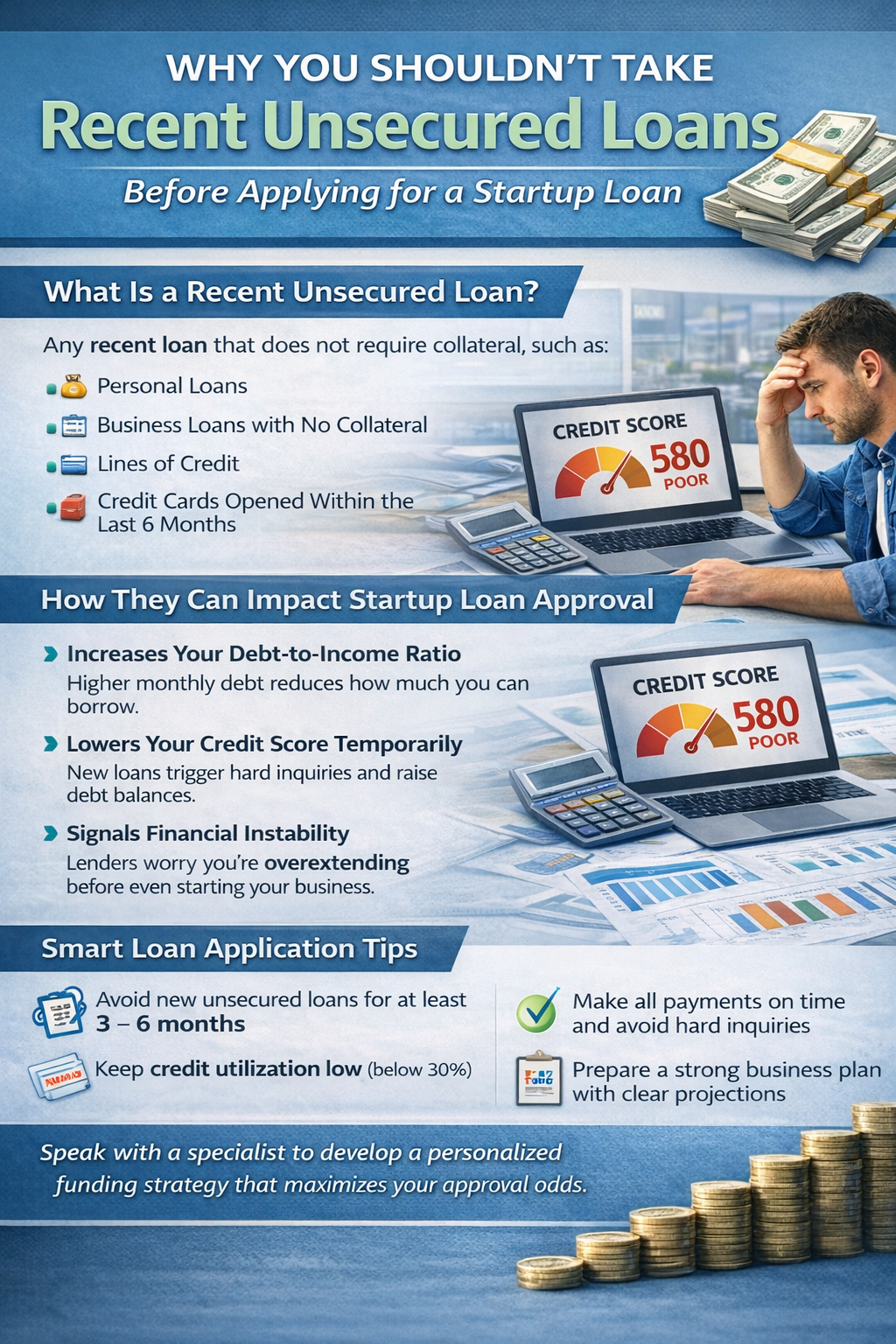
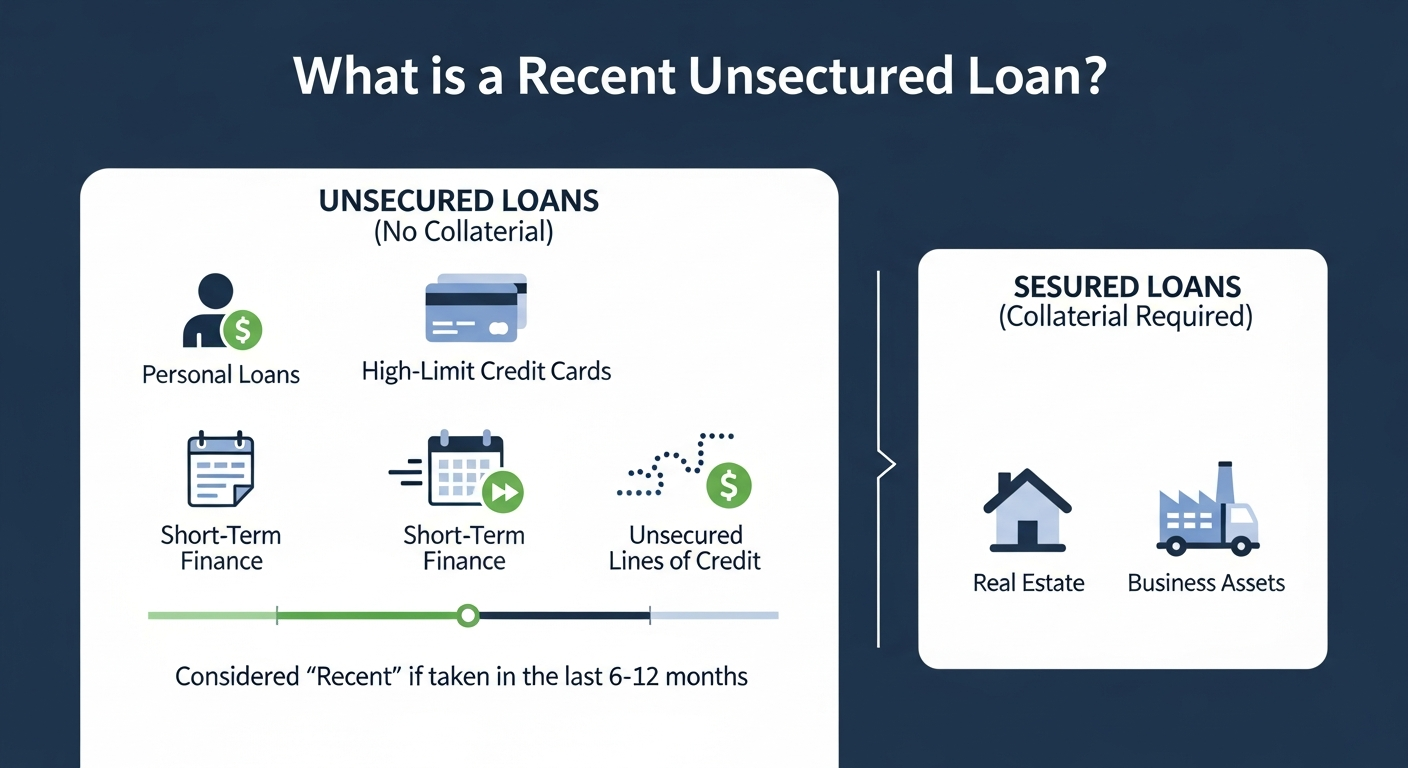
Common types of recent unsecured loans that lenders scrutinize during a startup loan application.
Before discussing the impact, it is important to define what a “recent unsecured loan” means in the context of applying for business financing, especially small business loans and SBA loans.
An unsecured loan is any borrowing that does not require collateral, such as real estate or business assets. These loans are often chosen because they are faster and easier to obtain than secured loans.
Common examples include personal loans used for startup costs, high-limit credit cards for working capital, short-term loans, and unsecured lines of credit.
“Recent” usually refers to loans taken within the last 6 to 12 months before applying for a startup loan. This is the timeframe lenders review most closely when evaluating financial behavior and risk.
These loans are attractive because they require less documentation than traditional bank financing. However, they often come with higher interest rates and shorter repayment terms. That can reduce your future borrowing power.
According to Purbeck Personal Guarantee Insurance, 46% of personal guarantee insurance applications in Q1 2024 were for unsecured loans. This highlights the level of personal risk often involved.

Taking a recent unsecured loan increases your monthly debt payments. This raises your Debt-to-Income (DTI) ratio and can make you appear riskier to startup loan lenders.
One of the most immediate effects of a new unsecured loan is its impact on your DTI. Lenders closely review this number to determine whether you can manage your current debt and take on additional payments.
DTI is calculated by dividing your total monthly debt payments by your gross monthly income. A higher DTI means more of your income is already committed to existing obligations, leaving less room for new loan payments.
For example, if your DTI is 30% and you add a personal loan with a $500 monthly payment, your DTI increases. That increase could push you beyond what many lenders consider acceptable.
Startup loans already carry more risk because new businesses lack repayment history. A high DTI becomes a major red flag. Lenders want to see that you have enough income to comfortably handle new payments.
This is especially important for small business loans, where founders often rely on personal income to support early cash flow. Increasing your DTI with recent unsecured debt can reduce your borrowing power and, in some cases, lead to denial.
Your credit score is a key part of your financial reputation. It plays a major role in qualifying for business loans and startup loans.
When you apply for new credit, including an unsecured loan, your score can temporarily drop. First, the application creates a hard inquiry on your credit report. Multiple hard inquiries within a short period can signal that you are actively seeking credit, which lenders may see as increased risk.
Second, opening a new unsecured loan can raise your credit utilization ratio. This is especially true if it involves a credit card or line of credit that is quickly used. Most lenders prefer utilization to stay below 30%. A sudden increase can lower your score.
Although credit scores can recover over time, a recent drop caused by unnecessary unsecured borrowing can hurt your startup loan application. This is particularly important if your credit is already borderline. Even small decreases can affect approval for conventional or SBA loans.
A strong credit profile depends on consistent, responsible repayment and stable credit behavior.
Beyond measurable factors like DTI and credit score, lenders also look at overall financial stability. They assess patterns, behavior, and decision-making.
A recent unsecured loan can raise concerns during a startup loan review. Lenders may ask why the debt was taken on. Was it for an emergency? Was it used to cover cash flow problems? Or does it suggest a lack of clear financial planning?
Startup loans already carry higher risk because new businesses have limited history and unpredictable cash flow. When lenders see recent unsecured debt, especially without a clear business purpose, they may question your financial strategy.
This can create a perception of instability. Lenders want founders who show discipline, planning, and long-term thinking. Taking unsecured loans for “validation” or short-term fixes may appear reactive rather than strategic.
Strong preparation and clear intent help build confidence. Unclear borrowing patterns can reduce it.
The ideal waiting period after taking a recent unsecured loan depends on the lender, the type of loan, and how it affects your overall financial profile.
As a general guideline, most lenders prefer that you wait at least 3 to 6 months before applying for a startup loan. This gives time for the credit inquiry to settle and for the new debt to appear consistently in your credit report and bank statements.
During this period, responsible credit behavior is critical. Make all payments on time. Keep credit utilization low. Avoid applying for any new credit.
If you used a credit card for working capital, pay down the balance. If you took out a personal loan, ensure payments are made consistently and on schedule.
This waiting period also allows you to strengthen your business plan, refine revenue projections, and prepare financial documents such as profit and loss statements, tax returns, and bank statements.
By taking a proactive approach, you present a more stable and reliable financial profile when you apply for your startup loan.
Timing is important, but it is not the only factor lenders consider when reviewing small business or startup loan applications. Approval decisions are based on a full financial picture, not just one detail.
Your overall credit history matters most. Lenders look at both recent activity and your long-term record of managing debt. Consistent, on-time payments show reliability.
Income stability is also critical. Lenders want to see steady, predictable income that can support repayment.
Your business plan plays a major role as well. It should clearly outline your market, competitive strategy, and realistic revenue projections. Lenders need confidence that your business can become profitable and sustainable.
Financial documentation is equally important. Accurate bank statements, balance sheets, and tax returns help demonstrate organization and transparency. A strong cash flow forecast showing the ability to meet future payments strengthens your case.
Finally, a solid Personal Guarantee backed by personal assets can increase lender confidence. Together, these factors create a more complete and trustworthy application.
In most cases, it is best to wait after taking out an unsecured loan before applying for a startup loan. However, there are limited situations where applying right away may still be possible. This usually happens when the new loan has little impact on your overall financial profile.
For example, if the unsecured loan was small and did not significantly increase your debt-to-income ratio, lenders may view it as less concerning. If the monthly payment fits comfortably within your income and does not strain your budget, the risk appears lower.
It also helps if your credit score remains strong and was not heavily affected by the inquiry or higher utilization. A solid history of responsible debt management can reduce the weight of one recent loan.
In some cases, the unsecured loan may have been used for early business validation or a small initial investment. If it is clearly documented and supported by a realistic repayment plan, lenders may consider the context.
Even then, lenders will carefully review your financial documents. A strong business plan and clear revenue projections are essential to offset any concerns. If the loan was part of a well-planned strategy and your overall financial metrics are strong, approval may still be possible. Still, moving forward with caution is wise. Consulting a financial advisor can help you make the right decision.
If you plan to apply for a startup loan soon, or if you recently took out an unsecured loan, there are steps you can take to strengthen your application. The goal is to present yourself as low-risk, prepared, and financially responsible.
First, avoid opening any new credit accounts before applying. This includes credit cards, personal loans, or store financing. Each new application creates a hard inquiry, which can temporarily lower your credit score. Instead, focus on managing existing accounts well. Keep utilization low and make every payment on time.
Next, prepare your financial documents carefully. Gather bank statements from the past 6 to 12 months, updated profit and loss statements, a balance sheet, and tax returns. Lenders want clear and organized records.
Your business plan must also be strong. Outline your market strategy, revenue projections, and detailed cash flow forecast. Show that you understand your industry and have a realistic path to profitability.
If possible, strengthen your application with personal assets or a Personal Guarantee. You may also consider structured options like equipment financing or a defined line of credit. This shows planning and discipline rather than uncontrolled borrowing.
Entrepreneurs are often driven by urgency and action. But when it comes to securing capital for your startup, strategy matters more than speed. Before applying for a startup loan, take time to review your financial position carefully and avoid taking on new unsecured debt.
What feels like a quick solution today can limit better funding options later. For example, using a personal loan to buy business equipment may seem convenient. However, it may not offer the tax benefits, lower rates, or stronger terms that equipment financing or a traditional small business loan could provide.
It can also increase your debt-to-income ratio and signal to lenders that you rely on higher-cost debt. Instead, focus on building a strong business plan, understanding your cash flow needs, and managing both personal and business finances responsibly.
A strategic approach creates a stronger foundation for your startup loan application and improves your chances of securing favorable terms.
Taking out recent unsecured loans before applying for a startup loan can have serious consequences. While these loans provide quick access to cash, they can lower your credit score, increase your debt-to-income ratio, and raise concerns about financial stability.
These factors may reduce your approved loan amount, increase your interest rate and APR, or even lead to denial. Lenders, especially those offering SBA loans or structured financing, want to see a strong application and a clear ability to repay. Recent unsecured debt can make them hesitant.
If your goal is to build a sustainable business, strategic planning is essential. Focus on preparing a strong business plan, managing cash flow carefully, and understanding financing options such as equipment financing, invoice financing, or lines of credit.
Instead of relying on quick unsecured loans, build a solid financial foundation. Review your bank statements, prepare accurate tax returns, and understand the impact of a Personal Guarantee. This proactive approach improves your chances of securing the right loan with favorable terms and supports long-term success.


Subscribe for our monthly newsletter to stay updated.

Open collections can impact your startup loan approval, but they don’t automatically disqualify you. Learn how lenders evaluate credit history, what matters most, and how to strengthen your application for business financing.
How long after credit damage can you qualify for a startup loan? While late payments, collections, or bankruptcy can impact approval, lenders focus on recovery trends, financial stability, and recent payment behavior. Learn how long different types of credit damage affect your eligibility and what steps you can take to improve your chances of securing startup funding faster.
Taking recent unsecured loans before applying for a startup loan may reduce approval odds, increase interest rates, and lower funding amounts. Learn how credit score impact, debt-to-income ratio, and timing affect your ability to secure business financing.