
Securing the right financing is a pivotal moment for any startup, often dictating the pace of growth and overall financial success. Entrepreneurs frequently face a critical decision: navigating the landscape of Small Business Administration (SBA) startup loans or turning to alternative lenders. Both pathways offer essential capital, but they diverge significantly in approval speed, eligibility requirements, cost, and their long-term impact on a business’s financial standing.
The choice between an SBA business loan and an alternative loan profoundly affects cash flow, growth flexibility, and a company’s financial trajectory. This comprehensive guide delves into the intricacies of SBA loans versus alternative lenders to empower founders in selecting the best fit for their unique goals and current situation. In fiscal year 2024, the SBA provided $37.8 billion in 7(a) and 504 funding, demonstrating its significant role in supporting small businesses Lending Tree, 2025.
Choosing between SBA startup loans and alternative lenders is not a one-size-fits-all decision; it’s a strategic calculation based on a startup’s unique circumstances, urgency, and financial readiness. SBA loans have a government guarantee, offering long-term affordability, lower interest rates, and longer loan terms. They suit established businesses with strong credit and are ideal for long-term projects like buying real estate. However, their rigorous eligibility requirements and longer approval times can be a barrier for businesses needing immediate capital.
Alternative lenders, like online lenders and private financiers, provide quick access to funds with flexible qualification rules. This makes them important for startups with less-than-ideal credit scores or urgent working capital needs. When comparing them, you must weigh the immediate access and flexibility of alternative options against the long-term cost savings and stability of SBA financing. Consider factors like loan amounts, credit score limits, and the purpose of the financing. The purpose could be real estate, inventory, or expanding operations.

SBA startup loans represent a specialized category of business financing designed to support entrepreneurs who might find it challenging to qualify for traditional bank loans. It’s crucial to understand that these loans are not directly issued by the U.S. Small Business Administration (SBA). Instead, they are originated and managed by a network of approved lenders, such as banks and credit unions. The SBA’s integral role lies in providing a partial loan guarantee, which covers a significant portion of the loan principal.
This government backing dramatically mitigates the risk for the originating lenders, thereby incentivizing them to extend credit to startups and small businesses that might otherwise be deemed too high-risk for conventional financing. The SBA oversees various key loan programs designed to meet diverse business needs, including the widely used 7(a) loans and the SBA 504 Loan program. In fiscal year 2024, the SBA supported about 103,000 financings, impacting small businesses with $56 billion in capital.
SBA startup loans are highly sought after due to their inherent stability and long-term affordability, although they typically necessitate patience and meticulous preparation from applicants. In contrast to financing options that promise rapid funding, SBA loans involve a more comprehensive review process meticulously designed to safeguard both the lender and the borrower.
The fundamental advantage of SBA loans resides in their exceptionally favorable terms, which often surpass those offered by alternative lenders or providers of short-term loans. The combination of lower interest rates and extended loan terms makes these loans particularly attractive for startups prioritizing sustainable growth over immediate capital access. These structured repayment schedules help alleviate the monthly payment burden, making it easier to manage cash flow.
Key SBA loan programs include the SBA 7(a) Loan, the most flexible and widely used, which can be applied to a broad range of business needs such as working capital, expansion, and equipment purchases. The SBA 504 Loan program is specifically designed for businesses needing funding for major fixed assets like real estate or long-life equipment, offering favorable long-term rates. For smaller funding needs, the SBA Microloan program provides up to $50,000.
To qualify for SBA loans, businesses typically need a strong personal credit score (often 650 or higher), a clear business plan, detailed financial statements, and proof of consistent business revenue. The eligibility requirements are stricter than many nontraditional lenders, and the application process is often lengthy and documentation-heavy. However, the loan guarantee provided by the SBA makes these business loans significantly more accessible to a wider range of businesses than traditional conventional bank loans.
Alternative lenders are a fast-growing part of the financial industry. They work independently from traditional banks and government programs like the SBA. This broad classification encompasses a diverse array of financing providers, including numerous online lenders, fintech companies, credit unions, and independent private lenders. Unlike conventional bank loans or SBA-guaranteed financing, these entities primarily leverage their own private capital to fund businesses.
The defining characteristic of alternative lenders is their paramount focus on speed and flexibility. Rather than adhering to the rigid, standardized criteria often found with traditional or SBA loans, these providers employ more dynamic risk assessment models. Lenders often focus on a business’s current performance. They look at steady revenue, cash flow, and overall health. They do not rely only on past credit scores or detailed financial records. The global alternative lending market was valued at $354.8 billion in 2023 and is projected to grow significantly, indicating its expanding importance Precedence Research, 2025.

Alternative lenders are a vibrant force in the business financing arena, widely recognized for their swiftness and accessibility compared to more traditional lending institutions. These providers are engineered for rapid operations, frequently delivering loan approvals and funding within days rather than the weeks or months typically associated with SBA or conventional loans.
This inherent convenience and adaptability, however, often come with a higher cost. This can manifest as increased interest rates or shorter repayment periods. This tradeoff between speed and cost is a critical consideration for business owners. The fast funding speed helps businesses with urgent opportunities. It also helps those facing immediate problems or needing quick working capital.
Alternative lenders offer a variety of loan types, including online term loans, business lines of credit, short-term loans, and accounts receivable financing. While loan amounts can vary, they often cater to needs ranging from small, immediate cash injections to larger investments. The eligibility requirements for alternative lenders are generally more flexible than for SBA loans.
Many providers place less emphasis on a pristine credit score or extensive business history, focusing instead on current business revenue, cash flow, and the overall viability of the business. This makes them a viable option for startups, small businesses with less-than-perfect credit, or those needing funds quickly. While interest rates may be higher, the speed and accessibility can be crucial for businesses that cannot afford to wait for more traditional financing.
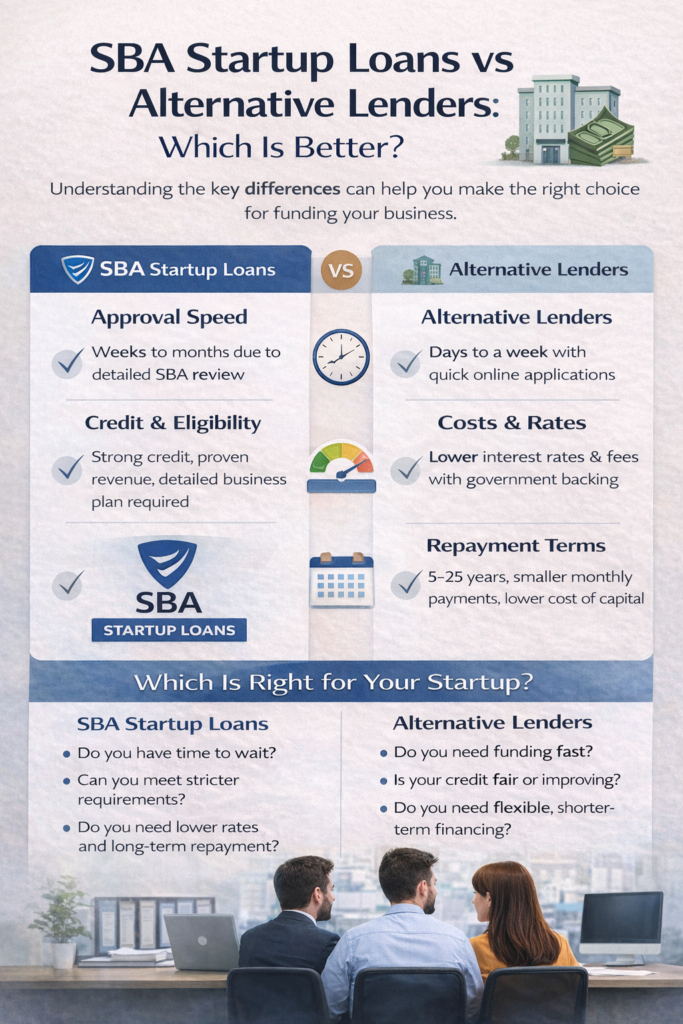
The timeline for securing funding differs dramatically between SBA loans and alternative lenders. SBA loans necessitate a detailed review and SBA approval, a process that commonly takes several weeks to several months. In contrast, alternative lenders, particularly online lenders, employ rapid, technology-driven processes that can deliver decisions within hours or days. They are often capable of funding loans within one to two weeks, making them an ideal solution for urgent needs or when capitalizing on time-sensitive business opportunities.
This speed is a primary reason why many startups initially opt for alternative financing. The alternative lending market was valued at $354.82 billion in 2023, reflecting its substantial and growing role in providing rapid capital solutions Precedence Research, 2025. This efficiency is achieved through streamlined online applications, automated underwriting systems, and a focus on readily verifiable data such as current business revenue and bank statements.
Qualifying for SBA loans and alternative lenders varies significantly. SBA loans typically mandate a strong personal credit score, often above 650, alongside a robust business plan, demonstrable business revenue, and comprehensive financial records. Lenders require evidence of sound financial management and a clear ability to repay. Alternative lenders have more flexible eligibility requirements. While good credit certainly helps, many providers accept fair credit scores, businesses with limited history, or even those with prior credit issues.
Their evaluation usually focuses on current revenue, cash flow, and overall business health, making them a practical option for startups that don’t yet meet strict SBA requirements. This flexibility is a key differentiator, opening doors for a broader range of entrepreneurs.
In 2023, only 44% of applicants received full loan approval from larger banks, highlighting the challenge many face with traditional lenders Fed Small Business, 2023. You usually need a strong personal credit score (often 650 or higher). You also need a clear business plan, detailed financial statements, and proof of steady business income.
The interest rate is a pivotal component in the overall cost of any business loan. SBA loans typically offer the most competitive interest rates, often structured as variable rates tied to the prime rate plus a modest spread, with interest rate limits established by the SBA. Their extended loan terms contribute to making SBA loans more cost-effective over time, reducing the total borrowing expense.
Alternative providers generally charge higher interest rates, reflecting the increased risk they undertake, particularly with newer businesses or those possessing weaker credit profiles. Furthermore, these lenders may impose additional fees, such as origination and application fees, which can elevate the total cost of borrowing. Founders should consider the full loan cost, including fees and interest, instead of focusing only on monthly payments.
Founders often enter business financing with passion but can miss key details that lead to expensive mistakes. A common error is choosing fast funding from alternative lenders solely based on speed, without fully appreciating the implications of shorter loan terms and higher monthly payments on their cash flow. They may focus only on interest rates or monthly payments, ignoring fees like origination or prepayment penalties, underestimating total loan cost. It’s vital to consider the full cost, not just the headline rate.
The loan term significantly impacts a business’s ongoing cash flow management. SBA loans are distinguished by their long repayment periods—extending up to 25 years for SBA 504 Loan program loans and up to 10 years for 7(a) loans used for working capital—which result in lower monthly payments and greater financial stability. This predictability is very valuable for businesses; it helps them reinvest capital and manage daily operations more effectively.
By comparison, alternative lenders usually provide shorter loan terms, commonly lasting between 6 and 18 months. These shorter durations necessitate higher monthly payments, which can strain a business’s cash flow. While a shorter term allows for quicker debt retirement, it demands robust business revenue and stringent financial management.
When comparing them, you must weigh the immediate access and flexibility of alternative options against the long-term cost savings and stability of SBA financing. Consider factors like loan amounts, credit score limits, and the purpose of the financing. The purpose could be real estate, inventory, or expanding operations.
There isn’t a universally “better” option when comparing SBA startup loans and alternative lenders; the optimal choice is entirely contingent upon a startup’s specific circumstances, readiness, available time, and financial strength. Both avenues present distinct advantages and disadvantages, catering to different business needs and developmental stages.
Grasping these details is critical to making informed decisions that support long-term growth without causing future financial strain. The main principle is selecting a loan that aligns with the business’s short-term needs, repayment capacity, and overall strategic goals. A thorough assessment of one’s financial profile and funding needs will invariably illuminate the most suitable path forward.

SBA loans have a government guarantee. They offer long-term affordability, lower interest rates, and longer loan terms. They suit established businesses with strong credit. They are good for long-term projects like buying real estate.
Alternative lenders, like online lenders and private financiers, give quick access to funds. They have flexible qualification rules. This makes them important for startups with poor credit or urgent cash flow needs.
Founders often approach the complex world of business financing with great passion but sometimes overlook critical details, leading to costly errors. One of the most frequent mistakes is applying for an SBA loan before fully understanding and meeting the eligibility requirements.
Applying prematurely, particularly with a low credit score, insufficient business revenue, or incomplete financial records, can result in rejection. Such rejections can negatively impact future creditworthiness and make obtaining any business loan more challenging. Another common pitfall is opting for fast funding from alternative lenders solely based on speed, without fully appreciating the implications of shorter loan terms and higher monthly payments on their cash flow. This can precipitate a debt cycle that severely strains operational finances.
Founders may focus only on interest rates or monthly payments, ignoring fees like origination or prepayment penalties, underestimating total loan cost. It’s vital to consider the full cost, not just the headline rate. Furthermore, failing to have a well-prepared business plan or accurate revenue projections can hinder applications for both SBA and alternative financing, as lenders need to assess risk and repayment capacity.
At Startup Loans USA, our core mission is to empower founders by delivering clarity and strategic guidance, rather than simply pushing products. We prioritize education and transparency, enabling business owners to make confident, informed financing decisions that truly support their growth. We recognize that selecting the right funding option can be daunting, especially when confronted with complex terms, varying eligibility requirements, and significant long-term financial implications.
Our role is to demystify this process, helping you understand precisely how each financing option will impact your business. We help founders by checking their funding needs. We explore all loan programs and compare SBA loans with alternative lenders. We also explain interest rates, loan terms, and collateral rules.
By adopting a consultative approach, we ensure that every recommendation is meticulously aligned with your specific goals, current financial position, and future growth aspirations, guiding you toward optimal Financial Solutions for long-term financial success.
SBA startup loans and alternative lenders each fulfill a vital and distinct role within the small business ecosystem. SBA loans benefit from government backing, which allows them to offer significant advantages such as affordability, lower interest rates, longer loan terms, and greater overall stability.
These loans are ideally suited for businesses that can meet the stringent eligibility requirements and are prepared to navigate the application process. They stand as a testament to the government’s commitment to fostering economic growth through reliable, government-backed loans. The 7(a) loan and 504 loan programs are particularly powerful for various business needs, from general working capital to substantial investments in real estate.
In contrast, alternative lenders are instrumental in assisting businesses that require capital quickly. They also serve businesses with more flexible eligibility needs or specialized funding requirements that traditional lenders may not easily accommodate.
Although they typically carry higher interest rates and shorter terms, their speed, accessibility, and flexible credit requirements make them valuable for startups and small businesses needing quick capital. Online lenders, credit unions, and private financiers collectively form a dynamic market that complements traditional financing by addressing the “financing gap.”
When comparing them, you must weigh the immediate access and flexibility of alternative options against the long-term cost savings and stability of SBA financing. Consider factors like loan amounts, credit score limits, and the purpose of the financing. The purpose could be real estate, inventory, or expanding operations.

Choosing between SBA startup loans and alternative lenders is not a one-size-fits-all decision; it’s a strategic calculation based on a startup’s unique circumstances, urgency, and financial readiness. SBA loans have a government guarantee. They offer long-term affordability, lower interest rates, and longer loan terms. They suit established businesses with strong credit. They are good for long-term projects like buying real estate.
However, their rigorous eligibility requirements and longer approval times can be a barrier for businesses needing immediate capital. Alternative lenders, like online lenders and private financiers, give quick access to funds. They have flexible qualification rules. This makes them important for startups with poor credit or urgent cash flow needs.
The trade-off for this speed and accessibility often comes in the form of higher interest rates and shorter loan terms. Understanding the nuances of each, including the specific benefits of 7(a) loans versus 504 loans, and the various offerings from alternative lenders, is paramount. By carefully assessing your business’s needs, financial standing, and timeline, you can select the business loan that will best support your path to sustained financial success.
Written by Jimy Delgado, from Startup Loans USA
Startup Loans USA helps clients find unsecured funding options for business startups, franchise purchases, home improvements, personal needs, and debt consolidation. Our team focuses on creating a simple, personalized funding experience designed to help you move forward with confidence.
Read our client testimonials or explore your funding options today.




Subscribe for our monthly newsletter to stay updated.
Unexpected business expenses can disrupt cash flow and slow growth. Learn how to build financial flexibility, prepare for surprise costs, and protect your business growth plans.
Understanding personal cash flow can help entrepreneurs plan for ongoing personal expenses while preparing for startup funding and building a new business.
Considering startup funding for equipment? Learn how to evaluate equipment costs, cash flow, financing options, useful life, and the potential impact on your business before making a purchase.